Travelling from Copenhagen to Hamburg by private transfer means arranging one vehicle for the journey between your chosen pickup and destination. It can be useful for colleagues travelling together, passengers with several bags, or anyone whose appointment is away from a railway station. For one traveller with a flexible schedule, the train or a long-distance coach may cost less.
The right plan depends on your destination address, travel date, passenger count and luggage. A journey via Rødby and Puttgarden uses a ferry; another road itinerary can avoid that crossing. Ask which route is proposed and confirm the complete quotation before booking. Travel conditions and ferry schedules can change.
For a Copenhagen to Hamburg enquiry, use our city-to-city transfer booking form. Include your pickup and destination addresses, the number of passengers and bags, and any time-sensitive appointment.
In this guide
- Copenhagen to Hamburg by private transfer
- Copenhagen to Berlin transfer
- Copenhagen to Kiel cruise port
- Copenhagen to Lübeck
- Rødby-Puttgarden ferry and the Fehmarn Belt
Copenhagen to Hamburg by private transfer

Hamburg is one of the city-to-city routes listed by Copenhagen City Transfer. The main advantage of a private booking is the agreed pickup and destination: the group can travel together from a hotel, office or other confirmed address to its destination in Hamburg. The driver handles the road journey, while passengers can organise the trip around their own meeting or onward travel.
Start with the exact addresses. A destination described only as Hamburg could be a hotel, a workplace or another location, each with a different final approach. Tell the booking team the date, preferred pickup time and the time you need to arrive. If you are collecting colleagues at more than one Copenhagen address, include each stop in the request instead of assuming a detour is included.
Choose the route with the whole itinerary in mind
One option uses the Rødby-Puttgarden ferry between Denmark and Germany. Another road journey travels through Denmark towards the land border. The proposed route can depend on current road conditions, ferry services and your destination. Ask for the route and an estimated arrival time for your actual day. Neither a ferry departure nor a road route should be assumed to guarantee a particular arrival.
Scandlines describes the Rødby-Puttgarden crossing itself as approximately 45 minutes. That is the sailing time, not the total journey. A car itinerary also needs time to reach the terminal, check in, board, disembark and continue to the destination. Check the operator’s current timetable and allow for changes.

Make a separate plan for any fixed appointment. Explain the deadline to the booking team and leave room for traffic, possible border checks and delays. An overnight stay before an important early meeting may be worth considering if missing the appointment would have serious consequences.
Train, coach, car hire or a private vehicle?
DSB offers direct train services between Copenhagen and Hamburg on some schedules. Check the current timetable, departure station, ticket conditions and any engineering work for the date you intend to travel. A train can be a practical choice when your pickup and destination are close to stations and each passenger can manage their own bags.
A coach may be cheaper still. Compare the actual departure and arrival points as well as the fare, and check baggage rules before buying a ticket. Car hire gives a licensed driver control over the trip, but requires the group to handle navigation, fuel, road charges, parking and the rental company’s cross-border conditions. A private transfer can be convenient for a group with a fixed address or bulky personal luggage, although it will generally cost more than a public transport ticket for one person.
Compare the full journey rather than one advertised price. Consider how you will reach the first departure point and continue from the arrival point, how many people are travelling, and the amount of luggage. Ask for a complete quote for the exact private itinerary rather than assuming that an additional stop or a return journey is covered.
Copenhagen to Berlin transfer

Berlin is a larger destination area than a single station or airport. For a transfer enquiry, specify the complete address and the entrance where passengers should be dropped off. If the journey is connected to a conference, identify the venue as well as the event name. A hotel, exhibition hall and meeting room may be in different parts of the city.
Copenhagen City Transfer lists Hamburg among its routes. For Berlin or another destination not listed on the site, ask the booking team to confirm availability and provide a quote before making onward commitments. Do not assume that a vehicle or route is available until the trip has been confirmed.
Plan a long-distance day realistically
For a longer road journey, give the driver and the booking team a clear picture of the day: preferred departure, arrival deadline, number of passengers, bags and any planned stop. Ask how the itinerary will be handled and agree any stops in advance. A meeting scheduled immediately after arrival leaves little room for an unexpected delay or a passenger who needs a break.
If a group is travelling for business, designate one lead passenger and send the final itinerary to everyone. Keep flight details separate from the intercity trip if some colleagues first arrive at Copenhagen Airport. Airport pickups include flight tracking, but the onward journey should still be agreed as its own itinerary.
Rail is a useful comparison for Berlin. Look up current Copenhagen-to-Berlin connections and any changes required; the route and timetable can vary. If you are considering a flight, compare the complete journey including travel to and from both airports and the time needed for airport procedures. The lowest fare is not always the shortest door-to-door plan, but public transport can be much more economical for an individual.
Give each passenger a clear plan
Share the pickup address, the confirmed time and a contact for changes. If several people are leaving different hotels, describe the collection sequence in the request. A single vehicle can keep a team together, but it may not be the best arrangement when passengers have different departure deadlines or carry more luggage than the selected vehicle can accommodate.
Copenhagen to Kiel cruise port
If you need to reach a cruise departure in Kiel, begin with the cruise line’s own documents. Check the ship, terminal, embarkation date and the latest time at which the line wants you at the terminal. Kiel has more than one cruise terminal, so the city name alone is not a sufficient destination for the driver.

Kiel is not one of the routes listed on this site. Ask for availability and a specific quotation before relying on a private transfer. Include the ship and terminal named in your documents, the number of travellers, the number and size of suitcases, and any mobility or access requirements. Confirm the terminal again if the cruise line changes its instructions.
Work back from the ship’s instructions
Use the boarding deadline as a constraint, not as an ideal arrival target. Allow time for the road journey, any ferry procedures on the chosen route and the cruise terminal’s check-in. For a departure that cannot be missed, consider travelling earlier or staying near the port the previous night. Ask the cruise line for its current embarkation guidance and the booking team for an estimate specific to the date and pickup address.
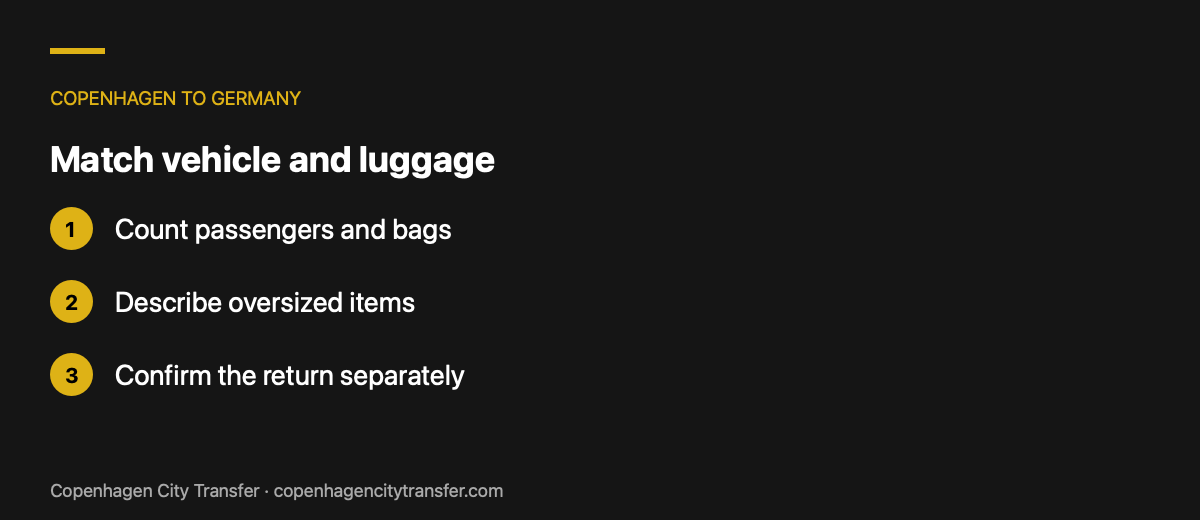
Passengers often travel to a cruise with more luggage than they would take to a meeting. Count each suitcase and tell the booking team about oversized items. A vehicle with enough seats for the group may not have room for every case. Give the confirmed load to the transport team and ask which vehicle is appropriate.
Compare independent travel
Train and coach connections can be worth checking, especially for a small party with manageable luggage. Look at the complete route to the named terminal, not just the arrival station in Kiel. Check whether a change is required and how you will cover the final leg. A taxi or local transport may be needed after an intercity arrival; check current options for your terminal and date.
If you drive a hired car, verify whether the rental agreement permits taking it across the border and where the car can be returned. Check the applicable parking arrangements if keeping the vehicle. Those details can make a substantial difference to the overall cost and convenience.
Copenhagen to Lübeck
For Lübeck, give the complete destination address and tell the booking team if you have an appointment or a scheduled onward departure. Streets and access arrangements near older city centres can be different from those at a hotel outside the centre. A confirmed entrance and a contact who can receive updates are more useful than a general instruction to drive to the city.
Lübeck is not listed among the site’s published routes. Request confirmation of availability and a quote for the exact journey. If you have a planned stop before reaching the final address, include it with the original request. Check whether all passengers will continue to the same destination or need separate drop-offs.
Keep the group and bags together
Choose a vehicle for both the number of seats and the luggage. Copenhagen City Transfer lists Business Sedan and First Class vehicles for up to three passengers and three bags, an SUV for five and five, a Van for seven and seven, and a Sprinter for twelve and twelve. These are stated capacities; describe unusual or oversized items when requesting a vehicle so the load can be confirmed.
For a small group, the train or a long-distance coach may cost less. Compare schedules, changes and final transport to the actual address. A private car can be useful where the group wants a common pickup and destination, but its convenience depends on a complete, confirmed itinerary. Car hire is another option for travellers who prefer to drive and have checked the rental conditions.
Make the return journey explicit
If you need to return to Copenhagen, include the return date, pickup address and passenger count in the enquiry. Do not assume a one-way quote includes a return. If some people are staying longer or travelling elsewhere afterwards, note those differences before the booking is finalised. A change to passenger numbers or the route may require a revised quotation. For a round trip, give the booking team both addresses in each direction and explain if a different hotel or meeting venue is involved. Send the final details to all passengers so they know where to assemble. If the return is tied to a flight, check the airline’s current airport arrival guidance and explain the flight deadline when requesting the pickup time. Keep a contact available for changes to either leg, and ask for the amended itinerary and price to be confirmed before relying on a change.
Rødby-Puttgarden ferry and the Fehmarn Belt
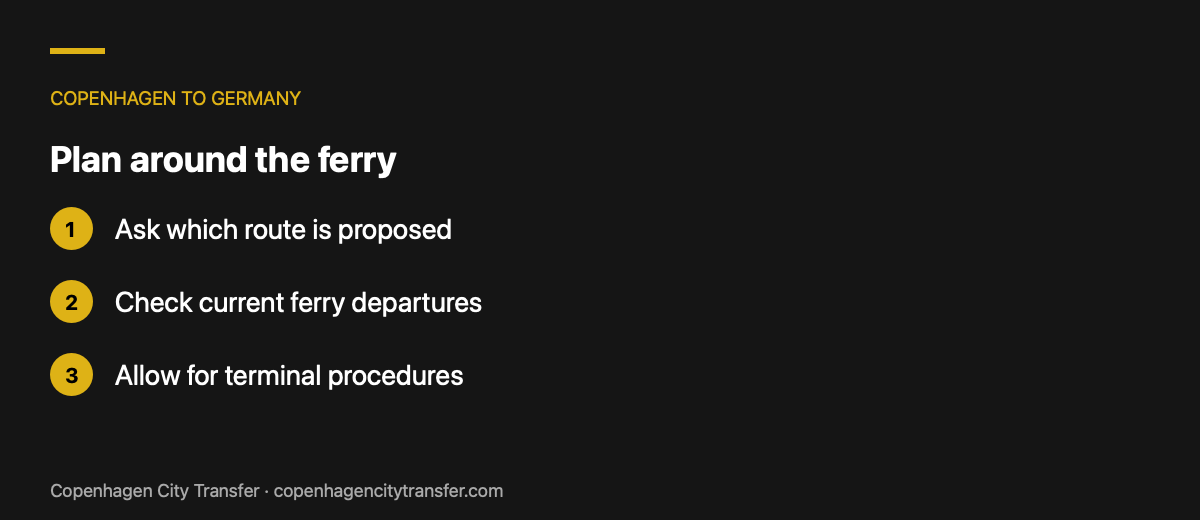
The ferry between Rødby in Denmark and Puttgarden in Germany is one possible part of a road trip between Copenhagen and northern Germany. Scandlines lists an approximately 45-minute crossing. Check its current departure information before travel: the sailing time is only one component of a complete road itinerary.
Ask the transport team whether your proposed journey uses the ferry, what is included in the quoted price and how the schedule is planned. Share any appointment or cruise boarding deadline at the enquiry stage. Weather, road traffic and changes to ferry operation can affect the day, so leave a practical margin and follow the instructions supplied for your confirmed booking.
What to clarify before departure
- The pickup address, destination address and the agreed number of stops.
- The route proposed for your particular journey and whether it uses a ferry.
- What the confirmed quotation covers, including any ferry or road charges applicable to the itinerary.
- The passenger and luggage count, including large cases or equipment.
- The time by which you need to arrive and a contact for any change.
- Current operator information and any travel documents each passenger needs.
The Fehmarn Belt fixed link is a separate construction project. Do not plan a trip on the assumption that it is already open or that a future opening date is guaranteed. For the day you travel, use the route and services confirmed for that journey.
Travel documents and border checks
Denmark and Germany are in the Schengen area, but temporary controls can be introduced. Each passenger should check the current requirements that apply to their nationality and carry the necessary travel documents. Allow for possible checks when planning a fixed appointment. The booking team cannot determine an individual traveller’s entry eligibility from a vehicle request.

Give the booking team a useful brief
Send a single itinerary with the date, pickup address, destination, desired departure and any firm arrival deadline. Add the passenger count and luggage, identify any planned stops, and say if the group needs a separate return journey. For a cruise, include the ship and terminal from the cruise line’s documents. For a business trip, specify the office or event entrance.
Fixed prices with no hidden surcharges are offered once the journey is quoted. Drivers arrive 15 minutes early, and cancellation is free up to 24 hours before pickup. Check the details of your individual booking, including any requested additional stops, with the booking team.
Use the city-to-city transfer form to request the specific route and vehicle. For a business itinerary that includes meetings in Copenhagen, our Copenhagen business travel guide covers local pickup and meeting planning.
Frequently asked questions
Can I book a private transfer from Copenhagen to Hamburg?
Hamburg is one of the routes listed by Copenhagen City Transfer. Send your date, addresses, passenger count and luggage through the city-to-city booking form to request a quotation.
Does every Copenhagen-to-Hamburg road journey use the ferry?
No. Ask which road itinerary is proposed for your journey. A route can use the Rødby-Puttgarden ferry or travel through Denmark towards the land border.
How long is the Rødby-Puttgarden ferry crossing?
Scandlines lists the crossing itself as approximately 45 minutes. Allow additional time for the roads, terminal procedures and the remainder of your journey, and check current departures.
Are there cheaper ways to travel from Copenhagen to Hamburg?
A train or long-distance coach can be less expensive for an individual traveller. Compare current fares and schedules, luggage rules, connections and travel to your final address.
Can I request Berlin, Kiel or Lübeck?
Contact the booking team with your dates and addresses and ask whether the journey is available. Those destinations are not among the routes listed on the site, so wait for confirmation and a quote before relying on a booking.
How much luggage can the vehicle carry?
Published capacities range from three passengers and three bags in the Business Sedan or First Class to twelve passengers and twelve bags in the Sprinter. Tell the booking team about oversized items so the vehicle can be confirmed.
Plan your journey: request a quote through our city-to-city transfer booking form.
Related guides
- Copenhagen to Hamburg by Private Transfer
- Copenhagen to Berlin Transfer
- Copenhagen to Kiel Cruise Port
- Copenhagen to Lübeck
- Rødby-Puttgarden Ferry and the Fehmarn Belt